
Motor, Not Mind
Why the battle over spelling is really a battle over the meaning of profound autism

PORTLAND, Oregon—There was a time when America confidently blamed “refrigerator mothers” for autism. If you’re too young to remember that grotesque chapter, let me summarize it for you: for decades, respected experts believed autism was caused by emotionally cold mothers who failed to bond properly with their children. Entire families were shattered by this theory. Mothers were blamed, children were institutionalized, and professionals spoke with absolute certainty about what autism was and where it came from. And they were catastrophically wrong.
That history matters right now because we are standing at another fork in the road in our understanding of autism—especially profound autism and non-speaking autism—and once again the institutions are behaving with the same certainty they displayed before. The modern version of the old assumption goes something like this:
if a person cannot speak, cannot reliably point, cannot perform on standardized tests, and exhibits repetitive movements or dysregulated behavior, then that person must be cognitively impaired.
That assumption underlies nearly everything in the autism world today. It underlies special education placements, IQ testing, therapeutic models, educational expectations, and perhaps most importantly, how parents themselves come to understand their own children. And I know this because I believed it myself.
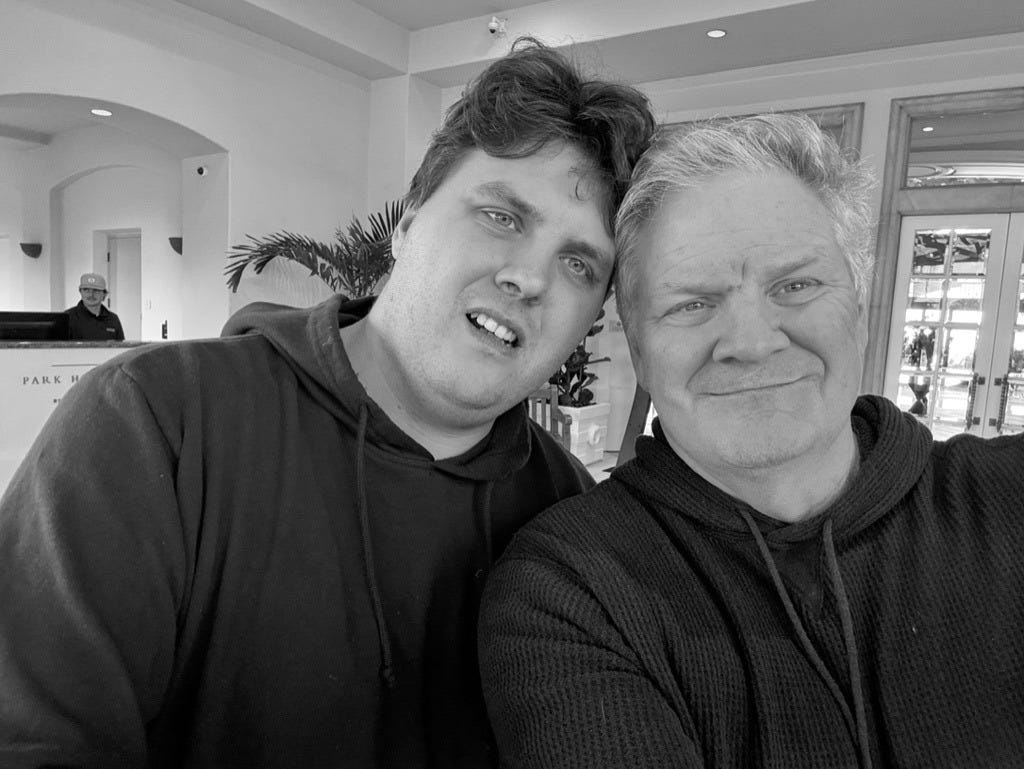
My son Jamie doesn’t speak. He never has. For years, the medical establishment treated him—and millions of children like him—as if the silence meant emptiness. It doesn’t. What Jamie and other nonspeakers have always lacked isn’t intelligence or thought or the desperate human need to be heard. They’ve lacked a method—a reliable pathway between their minds and a world that refused to meet them halfway.
But for most of Jamie’s life, I didn’t understand that. I thought my son had what my wife and I would privately call “the real autism.” I don’t mean that cruelly. I mean the kind of autism that leaves no ambiguity. Jamie didn’t speak. He stimmed. He had self-injurious behaviors. He was physically impulsive. He was placed in “life skills” classrooms where the expectation was not academic achievement but basic functional independence.
I remember sitting through progress meetings where well-meaning professionals carefully tried to avoid hurting our feelings while telling us, in effect, that our son’s future would likely consist of supervised living, simple routines, and basic daily functioning. Could he read? They didn’t think so. Math? Maybe some rote memorization. Abstract thinking? Impossible to know. Dreams, goals, aspirations? No one really had an answer.
Eventually, neither did I.
There’s a brutal moment in parenting a profoundly autistic child where hope itself begins to feel dangerous. Every autism parent I know understands this feeling. You try interventions, diets, supplements, therapies, hyperbaric oxygen, gut treatments, neurological protocols. You celebrate tiny gains and absorb crushing disappointments. Over time, you become wary of optimism because the emotional hangover from failed hope becomes too painful.
I reached a point where I told myself something I now look back on with profound sadness. I said to my best friend one day while Jamie stood nearby shredding leaves in our backyard: “It may be a blessing in disguise. Jamie has the kind of autism where he doesn’t even know he has autism. He’s oblivious and happy, not self-conscious. If we can just keep finding things that make him happy, maybe that’s enough.”
I believed that. And I was wrong—not slightly wrong, but wrong by a trillion miles.
The shift began in late 2019 when another autism parent sent me screenshots of her non-speaking son spelling sophisticated thoughts on a letterboard. I remember staring at the screenshots in disbelief. The language was too sophisticated, too reflective, too emotionally nuanced. It seemed impossible. And I want readers to really sit with that fact for a moment, because my first instinct was not belief. It was dismissal.
That reaction matters because it reveals how deeply the prevailing autism framework shapes all of us, including parents like me. Speech equals cognition. Limited speech equals limited cognition. Behavior reflects intellectual capacity. Life-skills classrooms reflect intellectual reality. The experts know. The institutions know. The tests know.
Except they don’t.
When I eventually traveled with Jamie to Virginia to meet Elizabeth Vosseller, founder of Spelling to Communicate, I thought there was virtually no chance this would work for my son. What happened in that room fundamentally altered my understanding of autism.
Not because someone held Jamie’s hand and magically produced Shakespeare. That caricature is precisely the dishonest sleight of hand critics depend upon. What I witnessed was something far more destabilizing. I watched my son—a child everyone assumed had profound cognitive limitations—begin spelling information presented moments earlier. I watched him answer questions, remain intensely focused, and reveal comprehension that simply did not fit the model I had been taught.
And perhaps most painfully of all, I realized that my son had likely been understanding far more than anyone around him had imagined for years.
That realization nearly destroyed me because suddenly every conversation held around him felt different. Every lowered expectation. Every “life skills” decision. Every assumption about his future. I began replaying his entire life in my mind.
Once you go through that shift, once you begin considering the possibility that profound autism may not primarily be a cognitive disorder at all, you start noticing something remarkable: the entire autism world is organized around the opposite assumption.
That is why this debate matters so much. This is not merely a dispute about one therapy or one communication method. This is a civil war over the meaning of profound autism.
There are now two competing frameworks.
The first framework presumes incompetence. In this model, speech is treated as a proxy for intelligence. Lack of verbal output suggests lack of thought. Dysregulated movement is interpreted behaviorally. Standardized testing is viewed as fundamentally reliable. Educational tracks emphasizing compliance and basic life skills are considered appropriate because cognitive expectations are presumed to be low.
This framework dominates autism institutions today. It dominates educational systems, state agencies, credentialing organizations, and perhaps most importantly, the billion-dollar ABA industry.
Now let me be very clear: many ABA therapists are compassionate people genuinely trying to help children. This is not an attack on individual therapists. But ABA is fundamentally rooted in a behaviorist understanding of autism. The underlying premise is that autistic individuals must be behaviorally shaped toward more functional and socially acceptable patterns of conduct through reinforcement, prompting, compliance training, and behavioral conditioning.
Beneath all of it lies an assumption about cognition. If a child cannot demonstrate understanding through conventional speech or motor pathways, the child is presumed intellectually impaired. That assumption drives everything.
Now compare that framework to the second model increasingly emerging from the spelling movement.
This framework presumes competence—not naively or blindly, but as a starting assumption. It asks a radically different question: what if many non-speaking autistic individuals possess far greater cognitive capacity than traditional testing reveals? And even more destabilizing, what if the core impairment in profound autism is not primarily cognitive at all?
What if it is motor?
Speech is motor. Pointing is motor. Typing is motor. Standardized testing requires motor output. What if we have spent decades measuring motor capacity and calling it intelligence?
That question is the earthquake beneath this entire debate.
Researchers studying apraxia, motor planning, and sensory-motor dysfunction increasingly recognize that many autistic individuals struggle profoundly with the execution of intentional movement. The challenge may not be generating thought; the challenge may be translating thought into reliable action.
As Elizabeth Vosseller explains, “Speech is 100 percent motor. Language is 100 percent cognitive.” That distinction changes everything.
And if this emerging motor framework is even partially correct, the implications are staggering. It would mean generations of non-speaking autistic individuals were systematically underestimated. It would mean educational systems confused motor impairment with intellectual impairment. It would mean many individuals placed into life-skills-only tracks possessed dramatically more cognitive potential than anyone realized. It would mean that people we assumed could not understand us may have understood nearly everything.
And it would also mean that some of the most powerful institutions in the autism world are built on a deeply flawed premise.
That is why the backlash against spelling has become so ferocious. Because spelling does not merely offer a communication method; it threatens an entire worldview.
Which brings us to Amy Lutz.
Lutz’s recent New York Times essay is important not because it contains especially sophisticated arguments, but because it perfectly captures the institutional mindset now colliding with the spelling movement. Lutz is the parent of a profoundly autistic son, just like me. And like me—for many years—she has concluded that her child’s limited speech reflects profound cognitive disability.
From that premise, what my son is doing must be impossible.
So instead of asking whether our understanding of autism may be incomplete, she reaches for a simpler explanation: it must all be facilitated communication.
That rhetorical move is the entire game. Everything—every form of spelling, every stage of communication development, every communicator—gets collapsed into one discredited category. Once the “FC” label is applied, critics believe the case is closed.
But this is profoundly misleading.
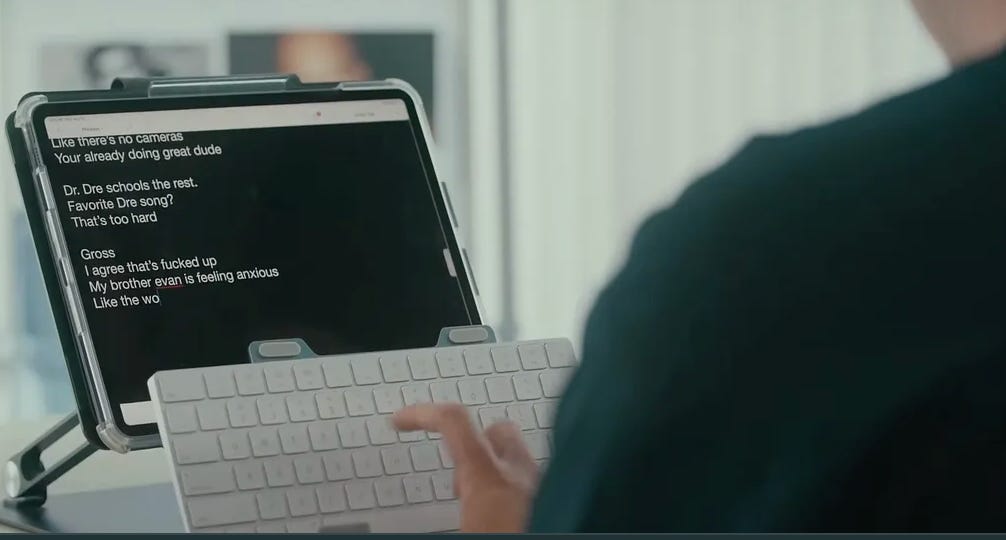
My son is not having his hand held while someone secretly authors his thoughts. No one is touching him. No one is moving his keyboard. No one is physically guiding his body. He types independently.
And this is where the logic of the critics begins to unravel. Because the farther communicators move toward independent typing, mounted keyboards, and autonomous communication, the weaker the classic facilitator-cueing explanation becomes.
Critics know this, which is why they increasingly shift from empirical claims to aesthetic ones. They tell you the movement “looks wrong.” They say the typing is too fast, or not hesitant enough, or too rhythmic, or too sophisticated. But none of that is science. It is intuition.
And autism history is littered with intuitions that later collapsed.
The refrigerator mother theory once “felt” right to experts too. So did institutionalization. So did the belief that autistic children lacked emotional attachment. So did the assumption that non-speaking meant intellectually absent.
Meanwhile, actual evidence continues emerging that complicates the simplistic dismissal narrative. At the University of Virginia, researchers led by Vikram Jaswal used head-mounted eye-tracking technology to study non-speaking individuals who spell to communicate. What they found was striking: spellers visually fixated on correct letters before pointing to them, and their timing patterns resembled planning processes seen in fluent typists.
Critics rarely engage seriously with this data. Instead, they continue treating the matter as closed. But closed scientific questions generally do not require this much rhetorical force to keep closed.
And here is another uncomfortable reality: Amy Lutz is not merely a neutral observer summarizing settled science. She has become an activist against spelling-based communication methods and has reportedly worked behind the scenes opposing legislation designed to protect communication access for non-speaking autistic individuals.
Readers of the New York Times likely imagine they are encountering a detached academic voice. They are not. They are encountering one side in an escalating ideological and institutional battle over the future understanding of profound autism.
And that battle is intensifying because the stakes are enormous.
The spelling movement is growing rapidly. Every year more non-speaking individuals move from letterboards to keyboards. More families report sophisticated communication. More educators begin reconsidering assumptions about cognition. More nonspeakers enter academic environments once considered impossible.
And increasingly, more people begin asking the forbidden question:
What if we’ve been wrong?
That question terrifies institutions built upon the old model because if profound autism is substantially motor rather than cognitive, then entire systems require reevaluation: educational systems, testing systems, therapeutic systems, funding systems, professional hierarchies, and research priorities.
Everything changes.
That is why this debate is becoming increasingly vicious. The institutions are not merely defending scientific caution. They are defending a paradigm—one with billions of dollars, entrenched professional authority, and decades of accumulated certainty behind it.
But here is the truth I cannot escape: I once believed exactly what Amy Lutz believes. I understand the temptation completely because the alternative is emotionally overwhelming.
To accept the possibility of hidden competence means confronting the possibility that your child has been underestimated for years. It means reconsidering conversations, educational placements, assumptions, and entire life trajectories. It means admitting that institutions you trusted may have misunderstood your child.
And perhaps most painfully of all, it means confronting your own participation in that misunderstanding.
I have had to live through that reckoning.
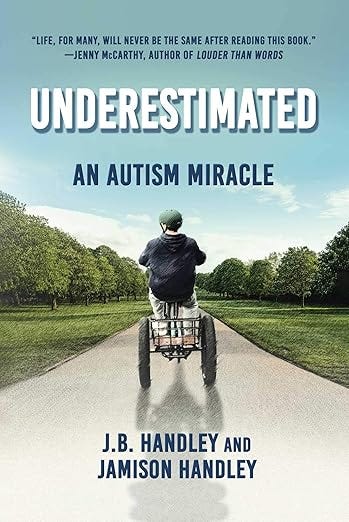
There is a moment from my book Underestimated that still haunts me. After watching Jamie begin spelling, Elizabeth Vosseller looked at me and said: “And he has seventeen years of ideas trapped inside his head.”
That sentence leveled me because suddenly I realized my son had likely been there all along—not absent, not empty, not unaware, but there, trying to bridge a motor system that would not cooperate.
Once you truly see that possibility, the moral stakes of this debate become impossible to ignore.
There is a reason the spelling movement has spread with such force among families of non-speaking autistic individuals. Parents are not merely seeing improved compliance or better behavior. They are experiencing something existential: the feeling of finally meeting their child. Dawnmarie Gaivin, one of the earliest and most influential advocates and founder of the Spellers movement, has often spoken about the profound shift that occurs when parents stop viewing their children through the lens of deficit and begin recognizing intentionality, intelligence, humor, frustration, and emotional depth that had always been there. That idea terrifies institutions built on the assumption that non-speaking equals intellectually impaired, because once enough families experience that shift, the old framework becomes impossible to fully restore.

This is where the concept of the “least dangerous assumption” becomes so important. If we presume competence and are occasionally wrong, the risk is that we expose someone to education and communication beyond their level. But if we presume incompetence and we are wrong, we imprison a mind.
That is the real danger.
Not false hope. Not parents daring to believe there may be more inside their children. The real danger is looking directly at a non-speaking person communicating independently and saying: “I don’t believe you.”
History suggests we should be extraordinarily cautious before once again declaring autism fully understood.
The experts once blamed refrigerator mothers. Today they confidently insist profound autism is fundamentally cognitive disability.
I believe future generations will look back on this era and realize we misunderstood non-speaking autism just as profoundly—not because these individuals lacked intelligence, but because we failed to recognize that the barrier was motor, not mind.
The tragedy is not that some parents dared to believe there was more inside their children.
The tragedy is how many institutions refused to look.
About the author
J.B. Handley is the proud father of a child with Profound Autism (P.A.). He spent his career in the private equity industry and received his undergraduate degree with honors from Stanford University. His first book, How to End the Autism Epidemic, was published in September 2018. The book has sold more than 75,000 copies, was an NPD Bookscan and Publisher’s Weekly Bestseller, broke the Top 40 on Amazon, and has more than 1,000 Five-star reviews. Mr. Handley and his nonspeaking son are also the authors of Underestimated: An Autism Miracle and co-produced the film SPELLERS, available now on YouTube.
"A new scientific truth does not usually prevail by convincing its opponents and making them declare themselves enlightened, but rather by the gradual death of the opponents and by the fact that the rising generation is familiar with the truth from the outset." Max Planck 1946, referring to physics, but the same phenomenon happens in every field.
Hi JB. I sincerely wish that everyone would understand precisely what you are presenting. Many do. Even those with another self-serving agenda. Like you, my entire life is devoted to our 33 y.o son.
I'd kill or die for him. Lawfully. Same oath I swore long ago when asked to defend our Nation.
I would do the same to protect your son. This is even though S2C did not yield results in his case. It did lead us to a painstaking set of tools commonly "acronym" based AAC device. Any progress is good progress. At any age and time.
So, I would like to say thank you for all the lives you touch. I sispect you know that your platform always opens new ways of thinking for those who have but one mission. The children.
Amy,... if your listening?
"The best way to destroy an enemy is to make him a friend."-
Abraham Lincoln